
• Skip to primary navigation
  • Skip to main content
  • Skip to primary sidebar
  • Skip to footer
  • The Americas
    • Europe
    • Australia
    • New Zealand
    • Africa

Search

Careers Contact Downloads |
  • About Us
    • Our History
    • Why Emydex
    • Our Team
    • Support
    • Video
  • Software
    • General
      • Systems Integration
      • Traceability Reporting
      • Quality & Compliance
      • Emydex Business Intelligence
    • Primary Processing
      • Procurement & Transportation
      • Kill Line Software
      • Animal Payments
    • Secondary Processing
      • Carcass Management
      • Packing & Processing
      • Production Planning
      • Yields & Costings
    • Further Processing
      • Recipe Formulation
    • Warehouse & Distribution
      • Warehouse Management
  • Your Industry
    • Beef
    • Lamb
    • Pork
    • Poultry
    • Fish and Seafood
    • Fresh Produce
    • Further Processing
    • Cold Storage
    • Other Processing
    • Your Role
      • Production Managers
      • Finance Managers
      • I.T. Systems Manager
      • Quality & Compliance Software
      • Warehouse Management Software
  • Customers
  • Our Markets
    • Emydex Africa
    • Australia
    • New Zealand
    • Ireland & Europe
    • The Americas
  • News
  • The Americas
    • Europe
    • Australia
    • New Zealand
    • Africa

Emydex

Food Processing Software Solutions

  • About Us
    • Our History
    • Why Emydex
    • Our Team
    • Support
    • Video
  • Software
    • General
      • Systems Integration
      • Traceability Reporting
      • Quality & Compliance
      • Emydex Business Intelligence
    • Primary Processing
      • Procurement & Transportation
      • Kill Line Software
      • Animal Payments
    • Secondary Processing
      • Carcass Management
      • Packing & Processing
      • Production Planning
      • Yields & Costings
    • Further Processing
      • Recipe Formulation
    • Warehouse & Distribution
      • Warehouse Management
  • Your Industry
    • Beef
    • Lamb
    • Pork
    • Poultry
    • Fish and Seafood
    • Fresh Produce
    • Further Processing
    • Cold Storage
    • Other Processing
    • Your Role
      • Production Managers
      • Finance Managers
      • I.T. Systems Manager
      • Quality & Compliance Software
      • Warehouse Management Software
  • Customers
  • Our Markets
    • Emydex Africa
    • Australia
    • New Zealand
    • Ireland & Europe
    • The Americas
  • News
  • The Americas
    • Europe
    • Australia
    • New Zealand
    • Africa
  • About Us
    • Our History
    • Why Emydex
    • Our Team
    • Support
    • Video
  • Software
    • General
      • Systems Integration
      • Traceability Reporting
      • Quality & Compliance
      • Emydex Business Intelligence
    • Primary Processing
      • Procurement & Transportation
      • Kill Line Software
      • Animal Payments
    • Secondary Processing
      • Carcass Management
      • Packing & Processing
      • Production Planning
      • Yields & Costings
    • Further Processing
      • Recipe Formulation
    • Warehouse & Distribution
      • Warehouse Management
  • Your Industry
    • Beef
    • Lamb
    • Pork
    • Poultry
    • Fish and Seafood
    • Fresh Produce
    • Further Processing
    • Cold Storage
    • Other Processing
    • Your Role
      • Production Managers
      • Finance Managers
      • I.T. Systems Manager
      • Quality & Compliance Software
      • Warehouse Management Software
  • Customers
  • Our Markets
    • Emydex Africa
    • Australia
    • New Zealand
    • Ireland & Europe
    • The Americas
  • News
  • The Americas
    • Europe
    • Australia
    • New Zealand
    • Africa

Markets

Home / Archives for Markets

Clogherhead Fishermen’s Co-Op: Labelling at Sea

14th June 2017

Fish Processing – Clogherhead Fishermen’s Co-Op

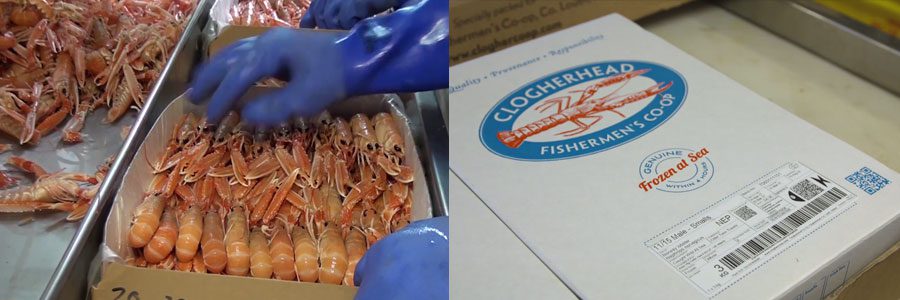
Clogherhead Fisherman’s Co-Op, is a leading Irish Seafood producer based in Clogherhead, Co. Louth, on the East Coast of Ireland. This video describes how Clogherhead Co-Op use Emydex’s Production Management and Traceability software on their fleet of trawlers as well as throughout their processing factory for data capture, labelling of product at sea, landings, into-warehousing, sales order picking and dispatch, providing Clogherhead Co-Op with real-time and accurate Traceability reporting from boat-to-truck.

Emydex’s Labelling at Sea software operating on the fleet of twelve frozen at sea trawlers, enables on-vessel printing, meaning product arrives to shore already labelled, saving time and ensuring full Traceability from the boat to the customer.
<!–Clogherhead Co-Op Video–>

Fish Processing and Traceability

Processing and Traceablility

Project Highlights

“The key for me is that Emydex were able to provide Clogherhead with their standard fish system built in consultation with BIM (Irish Fisheries Board), the SFPA (Seafood Fisheries Protection Agency), as well as the GS1 (Global Standards agency), but allow Clogherhead to tailor and tweak the system to suit our specific needs and processes exactly.
Aside from our old factory floor system, we also previously operated a bespoke-built boat invoicing and payments system.

Emydex were able to configure and build into their standard Fish system, the very same functionality as our previous system, meaning we now have everything we need in a single system, supported in-life by the Emydex support team. After a year at sea, the Co-op that includes the factory and fleet of boats all see the efficiencies and savings realised from our new labelling-at-sea systems”

Paul Boyd, Managing Director – Clogherhead Co-Op

“This project included a first for Emydex, in that our software is now operating on a fleet of boats in an offline environment, but at the same time has proved very successful. Hopefully over time this is something that will be adopted by the fishing industry as a whole”

David McMahon, Emydex CEO

Request a Demo

Filed Under: Customer News, Europe, Fish & Seafood, Industry News, Packing Management, Traceability Reporting, Warehouse Management, Yields & Costings

Help for Irish agri firms to move into African market

16th May 2017

With over 1.2m sq km of land, South Africa comprises Mediterranean, subtropical and semi-desert regions, producing everything from deciduous, citrus and subtropical fruit to grain, wool, cut flowers, livestock and game.

Its farm holdings range in size from the vast fields of the Eastern Cape to subsistence-based production in deep, rural parts.

When things become quiet around the Irish countryside, South Africa’s counter-seasonality offers agritech and farm-machinery producers an additional southern hemisphere market to provide a counterbalance to the end of a busy period back at home.

While some agricultural markets ‘down under’ have a strong indigenous farm machinery heritage, South Africa has a preference for imported European and North American equipment.

The good news is that, despite the weak value of the South African rand, European exports can compete on price. Irish companies active in the market include farm-machinery producers Keenan and McHale and food-processing software provider Emydex.

Other potential opportunities offered by South Africa’s large agricultural sector include animal nutrition and veterinary products, dairy and meat-processing equipment, alternative-energy solutions and water-saving technologies.

South Africa is the largest animal-feed producer on the continent, and there’s an ongoing opportunity to supply supplements to feed manufacturers, although this will mean taking market share from existing players.

Meat processing remains a large sector, particularly as the consumption of protein is increasing with a growing middle class. With the introduction of minimum-wage legislation there is a heavy focus on efficiency, with many South African farmers and processors looking to new technologies to increase productivity.

In selecting a South African market representative, companies should look for an agent or distributor that can provide an after-sales service and offer market reach right into the whole of the southern Africa continent. They may also be best advised to consider some of the smaller equipment suppliers, as larger distributors typically already have a full complement of partnerships in place and are less likely to take on new products.

In November, we will be taking a group of Irish farm equipment and agtech specialists on a market study tour to South Africa, providing an ideal opportunity to get a feel for the market, meet potential partners and showcase their products.

The visit will also take in Kenya, where agriculture accounts for 20pc of GDP, and tea and horticultural products are the country’s largest exports.

The Kenyan market represents yet a different opportunity again. The sector is characterised by small-scale farming, with family businesses typically operating on one-to-three hectare farms. However, the country is well capable of handling productivity gains thanks to a variety of climatic conditions, allowing for good grain, sugar cane, coffee and tea production.

Young Kenyans, who are leaving office jobs to venture into farming, are receptive to modernisation, and agriculture is central to the government’s economic development strategy. In 2010, Kenya signed a comprehensive Africa agriculture development programme to address constraints such as low investment and limited access to technology.

Irish animal-health company Cross Vetpharm has operations in Kenya, and those active elsewhere in East Africa include MagGrow, a start-up commercialising eco-efficient spraying technology; Hermitage Genetics, which specialises in pig breeding, and milking parlour specialist DairyMaster. There’s no doubt that other Irish firms selling to the agricultural sector could also look to Africa.

We here in Enterprise Ireland’s Johannesburg office can help with information, introductions and itinerary planning for market visits.

Natasha Siniscalchi-Dönmez is a Enterprise Ireland senior market adviser for Sub-Saharan Africa

Sunday Indo Business

Request a Demo

Filed Under: Africa, Press/Media, Uncategorized @us

EMYDEX TO EXHIBIT AT FIELDAYS EXPO, NEW ZEALAND, JUNE 2017

14th April 2017

WAIKATO - NEW ZEALAND:

Emydex Technology, with its head-quarters in Dublin Ireland, today announced plans to exhibit at the 2017 Fieldays exposition taking place at Mystery Creek in Hamilton, Waikato, North Island New Zealand from 14 – 17 June 2017.

Visit us at the The Ireland National Stand, No. D67-D73

Fielday - Largest Agricultural Trade Show in Southern Hemisphere.

Fieldays is the largest agricultural trade show taking place in the Southern Hemisphere. The agribusiness event attracts over 120,000 visitors and 1000 exhibitors each year.

Emydex’s local market distributor for Australasia, Ian Carson, based in Brisbane Australia, will be present on the Emydex stand for the duration of the show. The Emydex stand will form part of the larger Ireland Agribusiness village hosted by Irish Government agency Enterprise Ireland. As part of the Irish Agribusiness pavilion Enterprise Ireland will also be running a series of evening networking events to which customers, suppliers and interested parties will be invited to join.

Commenting on the expo, Mary Kinnane Enterprise Ireland Director for Australia/New Zealand said “Enterprise Ireland are delighted to have Emydex join other Agribusiness companies exhibiting on the Irish Agribusiness stand this year. I met with Emydex when they traveled extensively around Western and Eastern Australia this time last year, as well as both of New Zealand’s North and South Islands. Since then they now have three separate Australian meat processing plants and a distribution centre all running their Factory Floor Production control and Traceability reporting software systems with many other great opportunities in the pipeline.”

Ireland Agribusiness Stand at Fieldays 2016

Ireland Agribusiness Stand at Fieldays 2016

On the Emydex stand, Ian Carson and colleagues will have Emydex software demonstrations to hand of Emydex software systems configured specifically for the Australasian markets such as:

Abattoir System

Kill Line & Animal Payments software including:

  • The ability to record small stock EID data on the slaughter floor once this is compulsory.
  • NLIS database interface inbuilt in the system negating the need to use any 3rd party applications
  • An MLA certified eNVD solution integrated to the NLIS database and which provides the ability to create appointments from the eNVD data.
  • Flexible ‘three level’ payment grid with a second ‘fall through’ grid for animal that do not meet the criteria on the primary grid applied to the purchase.
  • Settlement schemes that automatically apply charges and rebates to supplier invoices associated with that scheme
  • A payment system that can pay Farmers (RCTI), Hobby Farmers (no GST), Agents etc.
  • AusMeat chiller assessment or a simply ‘grade only’ system

Emydex Kill line Grading Station

Boning Hall System

Packing & Processing software system module that includes:

  • Labelling of boxes, crates, packs, pallets, bins, containers
  • Input to/output from any manufacturing process
  • Process Yield Reporting
  • Control production against work orders (optional)
  • Capture and report on information by Department, Processing Line, machine /cooker / operator, lot / batch etc
  • Maintains full product traceability through processes

fieldday_packing

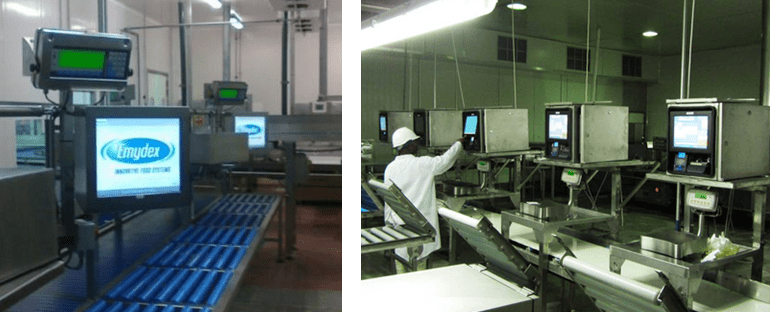
Emydex Packing & Weigh-Labelling Systems

Warehouse Management Systems

  • Warehouse Management System & Sales Order Processing
  • OzDocs Export Documentation
  • Inter-site Transfers
  • Inventory Stock reporting system, real-time visibility of stocks
  • Automatic stock reconciliations with Cold Stores, reducing time taken to track and reconcile external stock
  • Dual Units of Measure
  • Forwards and Backwards Traceability
  • Stock Maps – graphical queries of stock statuses
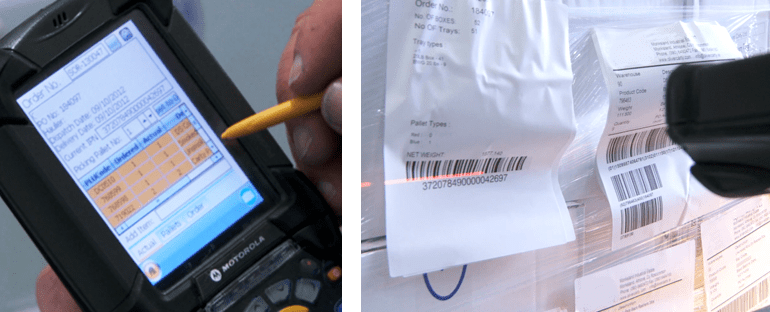
  • Handheld Scanning Application – Sales order picking & dispatch, Stock movements

Emydex Handheld Warehouse Stock Scanning

Quality Management System

  • Quality Survey Production Calendars
  • Survey Scheduler including reminders of missed, overdue or incomplete surveys
  • Survey Alerts (red, amber, yellow) via email, text or on Emydex client PCs Quality Survey Builder & Editor
  • Plant overview and location drill-down maps
  • Capture text, temperature, pictures, select from lists, Yes/No check boxes
  • Real-time data collection
  • Corrective Action Preventative Action (CAPA) workflow
  • Technical Department Document Management System
  • Real-time data retrieval of data captured by other Emydex modules installed e.g., product detail look-ups via bar-code scanning
  • Real-time data validation checks
  • Operates on both fixed position and portable data capture devices


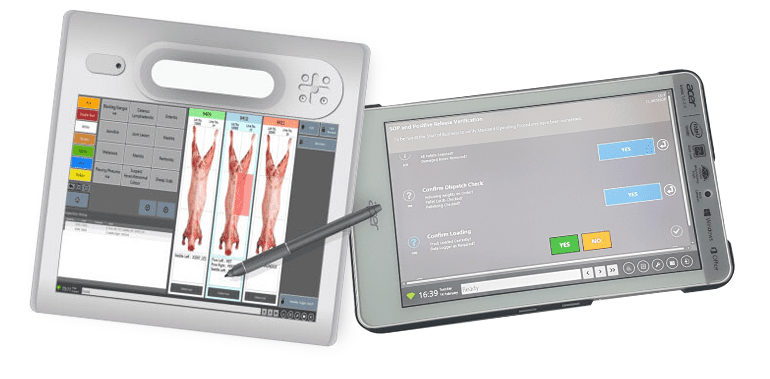
Emydex on mobile devices

Emydex Quality Surveys running on mobile tablet device

Software Demonstration

To book a software demonstration, please contact Ian Carson, Emydex Australasia distributor on:
Ian Carson ian.carson@emydex.com.au
Mt Nebo, Queensland, Australia 4520
T: + 61 (7) 3289 8336
M: + 61 4566 31662

Request a Demo

Filed Under: Australasia, Company Updates, Uncategorized @us

Yield & Costing Analysis in the Food industry

6th March 2017

NORTH AMERICA:

The food industry is no different than any other complex manufacturing business whose goal is to make a profit. If you are not able to calculate your true manufacturing cost, it could lead to lost profits, orders and customers. To remain profitable, you need to answer a number of questions; Are you pricing your products to make a profit? Are you producing the products at the cost you calculated? Are you contributing to overhead and profit levels to meet your strategic business goals?

In the food industry, there are very small margins, making it difficult for food companies to achieve and maintain profitability. One of the first lessons of accounting is the equation of Profit = Revenues – Costs

In the food industry, the volumes are fairly flat, growth is slow, so food processing companies need to be focused on managing costs as the best option to improve profitability. Determining what are the product and customer costs is not as simple as it seems in the food industry. Over the last 15 years many food companies have either gone out of business or been bought out by a larger company due to lack of profit.

Current state of ERP vendors able to support the food industry costing

Food companies are not able to calculate accurate costs with their current software systems due to limitations in these systems required to support food industry requirements. The quality and specification of raw materials vary significantly from vendor to vendor and at different times of the year. This is especially true in the meat industry where each species carcass is a different size and weight, so for example, each ham or loin produced has different amounts of lean/fat, bone and trim.

The process of blending, mixing and cooking can produce different yield losses depending on the attributes of the raw materials used, and the setup of the equipment. ERP vendor software is not designed to track and measure yield loss tracking as the product moves through the various food production processes.

Due to the limitations in the costing functionality, many companies use manual (spreadsheet) calculations to determine product costs. While spreadsheets may work for smaller, ad-hoc analysis, they fall short in handling massive complex costing processes due to their limitations with scalability, data integrity, integration and security. They are also open to clerical error (no validation), and are typically reliant on a few key individuals within the organisation. The ‘hit by a bus’ risk is a cause for concern.

Furthermore, manual cost calculations are then fed into some type of profitability analysis, but the challenge is that the manual data capture is flawed, making these analyses less than optimal. For food companies to survive in the current economy they require accurate and complete profitability information.

Addressing the challenge of calculating costs

From the big picture perspective, it is relatively easy to calculate profit. Total up all your revenue and expense accounts and calculate the difference between the two. This tells you that in total income made or lost, but at a macro level. The calculation of profit for specific products or customers can easily explode into a massive undertaking. Companies do not know where to look to address their profitability issues.

The current situation of limitations of profitable reporting is a direct correlation with the challenges the food manufacturers face when calculating accurate cost results – lack of an automated costing process, substantial manual processes, lack of operational measurement to ensure accuracy of results and lack of granularity.

Food companies have tried different approaches to address the costing requirement. They have tried sophisticated spreadsheets, in some cases using a network of complex spreadsheets. Others have attempted to modify their ERP or Financial (GL) systems to handle the advance costing needs of the food industry, but often these modifications fail to deliver a comprehensive cost system. Lastly, companies have embarked on building their own custom cost system from the ground up. While these systems will give the company exactly the costing system they want, it comes at a significant cost of time, money and resources.

Operational costing systems are the next generation of solutions created specifically to handle the complex costing and measurement environments encountered by food process manufactures. These package solutions that integrate with your existing ERP or Financial System allow companies to rapidly gain access to detailed cost data that that is specific to their food production process. Access to detailed product information brings a whole new level of insight on operation performance and arms the Operational Management team with information to effectively manage and implement continuous improvement projects to reduce costs.

By adding an operational costing and measurement system to the existing business systems, food manufactures can remedy many of the symptoms that produce an ailing cost process.

How Operational Costing in the Food Industry Improves Profitability

Your competitor just undercut your price, so to be competitive in the market you’re probably thinking that all you have to do is meet or beat your competitor’s price to get the deal. Let’s just reduce or eliminate the overhead contribution, and quote the price based on the materials and labour, then mark up the cost to meet the company profit margins. Right? Wrong. There are many manufacturing companies who price on the basis of what their competitors charge or the market price, without considering whether their competitors have a different cost structure or knowing their own true manufacturing costs. If you base your prices on what others are doing, you’ll never know if you’re taking in profitable business.

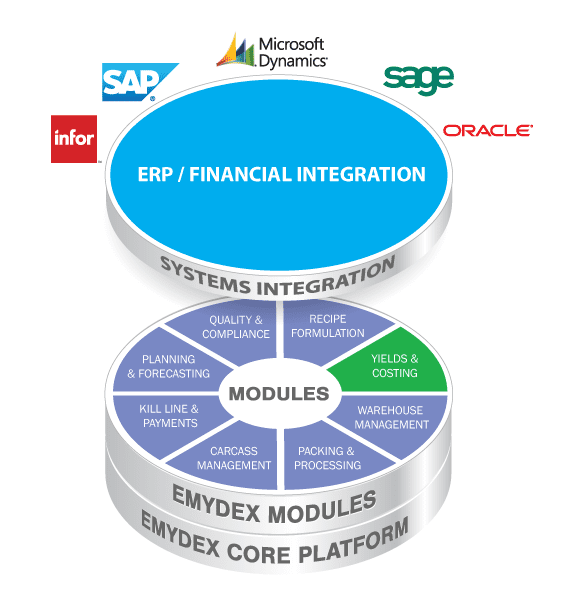
Instead, adopt a different approach that will bring in profitable business while remaining competitive, by implementing Emydex’s Yield and Costing Module that is a fully integrated component of the Emydex Production Management Platform, that is tightly integrated to your existing ERP or Financial System.

Emydex Yields Core

Yields & Costings Module, on Emydex Core Platform, integrated to back-office ERP

With the recipe BOM (Bill of Materials), Emydex is able to model the flow of raw materials, ingredients, packaging, resources and overhead through the food production process. By monitoring actual costs and product movement through the process, Emydex is able to generate yield variances, and measure the financial impact of production using standard reports to validate the accuracy of the costing standards.

These costs and variances can be integrated with your existing financial system to provide a more global analysis of profitability.

By knowing the true costs of producing products at your food plant, Emydex’s Yield & Costings software gives you the knowledge needed to make strategic and operational decisions that will keep your business profitable.

Terry McCorriston, Authorised Distributor, Emydex North America

Emydex Canada / North America
Terry McCorriston Consulting
28 McGibbon Crt
Kitchener, Ontario
Canada
N2A 3P2
T: + 001 519 500 0540

Terry McCorriston

LinkedIn – profile

Contact Sales

Email – sales@emydex.com

Request a Demo

Filed Under: North America, Product News, Uncategorized @us, Yields & Costings

Electronic Sheep EID / NLIS system for Sheep & Goats

12th February 2017

VICTORIA – AUSTRALIA:

With the compulsory recording of individual sheep RFID ear tags due to commence now in Victoria (June 2017), Emydex Technology, a world leader in Traceability software systems for the food industry, is well positioned to not only meet this new requirement, but also to add real value for small stock processors.

Emydex links directly to the National Livestock Identification System (NLIS) database, so data captured by the Emydex systems regarding received and processed animals, can easily be retrieved and uploaded the to the NLIS system.

By supplying a fully integrated system that links purchase appointments, deliveries, sale yard purchase data, animal welfare and quality assurance with on-floor processing data, a number of significant benefits are provided. These include data accuracy, minimal manual data input and full integration of the supply chain.

‘By integrating Emydex’s RFID data capture solution into the processing and payment chain, Wodonga Abattoir can gain full traceability and true individual carcass costing whilst complying with the new regulatory requirements. This gives us significant benefits and reduces manual data input by leveraging the inbuilt NLIS integration and sophisticated costing system that Emydex provides’. Rod Scarvell, Wodonga Abattoir.

P&L by Animal

A key feature of the Emydex system is the ability to produce a ‘P&L for every animal processed’ without having to manually key costing data or averaging costs over multiple animals.  By automatically processing the XML post sale datafiles as supplied by the saleyards, not only is the purchase data for each lot recorded and the lots for processing automatically created, the individual RFID (ear tag) numbers are stored against the supplying agent and the price paid.

This RFID data can then be matched back to the agent on an animal by animal basis, irrespective of when processing occurs or if stock is mixed prior to processing.

Additional costs can be applied by default on a saleyard or direct supply basis and can include freight, droving and, branding costs, commissions etc. so the full cost of each animal delivered to the yards can be determined.

Flexible Payments

With a user definable payment grid combined with the ability to include expected skin and other revenues the true cost of the stock to the processor is available. It is also possible to generate the slaughter floor costs (kill fee) for all purchases so stock can be costed ‘to the boning room’.

Naturally this also allows for the production of recipient created tax invoices, agent reporting, AUSMEAT feedback sheets and government levy accruals etc. which can all be emailed directly from the system to the relevant parties.

eNVD system

Emydex is also one a few ‘integrated’ systems that is certified by the MLA to integrate to the new eNVD system and thus provides the ability to receive NVD data electronically, which is fully integrated to other Emydex system modules. This provides the ability to not only store the relevant data from a legislative point of view, but also to utilise this data to drive the rest of the system by matching received livestock to the eNVD and then to the lairage, kill agenda and payments with minimal data input.

Being a fully integrated, flexible system built on modern .NET technology, with powerful on-floor data collection systems linked to a user-friendly back office system, Emydex, a system proven in over 30 livestock processing plants around the word, is able to offer the following advantages .

Emydex Sheep EID system benefits include:

  • The ability to create ‘appointments’ and lairage lots direct from the purchase advice data sent by the sale yards with no manual input (XML file)
  • The ability to match individual small stock animals back to the agent details of the appointment via the RFID to obtain the true cost of the animal (for costing).
  • The ability to add additional costs to a sale yard purchase such as agent commissions, droving, transport (up to three transport companies per purchase), feeding etc. all of which can be defaulted by sale yard provider. This then provides a true cost of stock to the plant by animal.
  • Track sale yard average costs for boxed lots if not RFID tagged.
  • Report on costs by provider (i.e. all freight or droving costs by supplier for a time period) to match to supplier invoice for reconciliation.
    The ability to record small stock EID data on the slaughter floor.
  • NLIS database interface inbuilt in the system negating the need to export/import or use any third-party applications. By having all of the current holdings etc. in the Emydex database (automatically downloaded) information can easily be match automatically to kill records.
  • An MLA certified eNVD solution integrated to the NLIS database and which provides the ability to create appointments from the eNVD data.
  • Flexible ‘three level’ payment grid with a second ‘fall through’ grid for animal that do not meet the criteria on the primary grid applied to the purchase.
  • Settlement schemes that automatically apply charges and rebates to supplier invoices associated with that scheme.
  • Record charges that apply to the invoice plus charges that are plant costs e.g. ‘processing levy’.
  • An optional facility to update any kill data from the back office after the kill.

Emydex Sheep Payments system benefits include:

  • Farmers (RCTI)
  • Hobby Farmers (no GST)
  • Advise agents of revenues for agent supplied over the hooks purchases (Buyer Advice).
  • Match sale yard agent invoices to the stock killed. Also allow for combine payments to the sale yard itself (VLE).
  • Record sheepskin sales and generate RCTIs to the purchasers.
  • Allow for the recording of all costs associated with a service kill and invoice those based on number of head processed.

Other system benefits include:

  • Email reports directly from the Emydex application without printing, scanning and emailing. Combine RCTI and feedback sheet as one email to supplier.
  • The ability to store general ledger codes per transaction type (e.g. fees, levies, purchase types etc. he facilitates the interface into accounting systems. Note interface not standard).
  • Flexible, easy to use data collection screens that can be combine or separated as required (i.e. a separate sex and dentition station or both functions on one).
  • Standalone grading stations that can run without the previous stations being available.
  • The ability to switch, at the flick of an on screen ‘switch’, between grading printers (for different ticket sizes etc. or in the case of a printer break down).
  • The ability to take an input from a panel reader and change to a wand reader should the panel reader fail (again at the flick of an on screen ‘switch’).
  • Data collection screens that can increment body numbers automatically and only be updated when necessary i.e. a breed station that only need to be updated if the breed needs to be recorded for a particular animal.
  • Inbuilt QA system with transport quality (cleanliness, bruising points etc.) and animal welfare check forms (which is able to be used in all the Emydex modules to provide a full quality management system).
  • Modern ‘.NET’ Microsoft SQL Server database environment.
  • Inbuilt report writer that allows IT Staff to generate reports in house.
  • Over 30 Emydex staff worldwide to support the application.
Request a Demo

Filed Under: Australasia, Industry News, Kill Line & Settlements, Lamb, Product News, Uncategorized @us

Stock Control & Dispatch System live in Wodonga

11th January 2017

VICTORIA – AUSTRALIA:

Established in 1965, Wodonga Abattoir is a leading export-focused multi-species meat processor, based in Northern Victoria, Australia. Wodonga Abattoir processes approximately 45,000 tonnes of meat per annum, including 70,000 cattle, 1,200,000 sheep and lambs, 10,000 Bobby Calves and 300,000 goats. Their products are 100% processed for export markets including USA, Canada, Mexico, Japan, Korea, Russia, South Africa, Indonesia, China, Malaysia and Middle Eastern Countries and hold both Halal and Organic Certifications.

Warehouse Management System & Sales Order Processing

Wodonga approached Emydex in 2016 with a requirement for a flexible Warehouse Management system that would work in tandem with their existing internal IT systems, but would offer them more accurate and faster reporting across the organisation. They needed a system that covered Sales Order Entry as well as Dispatch, that also managed transfers of stock between their main site and external Coldstores, as well as dispatches from the external Coldstores to end customers. They also needed a centralised data repository to consolidate and integrate departmental data and a system that could grow as required with the option to implement additional modules at a later stage.

As Wodonga are an export focused processor, they needed a system that could operate in foreign currencies, that could be linked to a particular vessel leaving Australia for export markets. Finally, they needed a system that could interface with OzDocs, an Australian export documentation system.

OzDocs Export Documentation

As part of the Emydex Product File setup for Wodonga, Emydex configured a new export tab specifically for the meat standard cut codes in Australia, that are used to describe export products. Export data is sent, along with the units and weights, production dates etc. to OzDocs, which is then able to communicate with the regulatory authorities and produce the necessary physical documentation. In Australia, a statutory requirement for exporting goods is the ability to assign port mark stamps to items for export. Emydex’s Australian system is now configured such that assigning Port Mark stamps to box labels is a very quick and easy process, fully audited, and allows Wodonga to decide how they are going to assign Port Marks on each shipment.

Inter-site Transfers

Another feature Emydex added was the ability to scan items (both cartons and carcasses) to a ‘transfer’ order to track it leaving the plant, as well as the ability to re-scan back into stock at the other end. This can be an automatic transfer where goods are ‘auto received’ into sites where there is no integration in place between Emydex and the receiving site’s system, or they can be scanned in at the pallet level to confirm receipt where Integration is in place. As part of this process Wodonga can print an ‘MTC attachment’ which describes the export markets the product can be sent to and reduces the manual paperwork involved in transferring stock.

Inventory Reporting

Emydex provided Wodonga with an advanced Inventory Stock reporting system, providing real-time visibility of stock across the organisation, including reports for 3rd Party Cold Stores, detailing what stocks have been dispatched on their behalf. Wodonga now have automatic stock reconciliations with Cold Stores, significantly reducing the time taken to track and reconcile external stock.

Dual Units of Measure

As part of the inventory management system, Emydex allows Wodonga to view their stock in one unit of measure, such as KG’s for example, but then to price/sell products in a different units of measure such as lbs and pieces (units). “The ability to procure, store, and sell products in different units of measure is an area standard ERP systems really struggle with”, said Ian Carson of Emydex Australia “the fact that Emydex was designed to specially cater for such scenarios is one of the big differentiators between Emydex and other factory floor systems” he added.

Commenting on the project, Rod Scarvell of Wodonga said “Overall there have been some great speed improvements and efficiencies with the introduction of Emydex in Wodonga. The company now has better visibility of inventory stocks across the extended organisation, so the benefits of installing Emydex are immediately obvious”

Due to the nature of the company, Wodonga Sales Orders are typically quite large. Emydex provided Wodonga with functionality that enables the company to break down large sales orders into smaller ‘dispatch’ orders that they can track and invoice, while at the same time retaining links to the larger overall Sales Orders.

Forwards and Backwards Traceability

As with all Emydex systems, full backwards and forwards traceability reporting is included as standard. Wodonga can easily track all movements of stock including movements and dispatches that happen at the External Coldstores. The forward and backwards traceability reporting allows operators to find quickly and easily, what Sales Order a box was dispatched on or vice versa, find what Boxes went out on all Sales Orders.

Emydex System Benefits

Wodonga now have a simple, consistent and clean user interface which has been readily adopted by their users. By using the Emydex in-built report writer, Wodonga’s IT users now have the ability to write their own reports, eliminating the reliance and cost for external technical support. With the removal of the need for a separate ‘reporting’ database, reporting accuracy and speed have been greatly improved.

Commenting on the project, Rod Scarvell, IT Manager with Wodonga Abattoir said “we had been talking to Emydex for almost 3 years before we made the decision to implement their factory floor IT system. The Implementation itself went very smoothly, so much so we decided to change some of our internal work practices along the way to suit the system, ultimately improving the business. The Emydex project manager kept everybody on track and ensured each person got their required jobs done in a timely manner, and their Lead developer and local representatives were very knowledgeable about not only the Emydex product but also how this related to our particular business processes. The main advantages of Emydex we see at this early stage are the company now has better visibility of inventory stocks, coupled with the overall speed of operation, and system running on a modern SQL platform. Post go-live the follow up from the Helpdesk support team for any issues that arise has been excellent.”

For more information on our Beef Processing Software click here

Request a Demo

Filed Under: Australasia, Beef, Customer News, Industry News, Kill Line & Settlements, Packing Management, Traceability Reporting, Warehouse Management

  • « Go to Previous Page
  • Page 1
  • Interim pages omitted …
  • Page 12
  • Page 13
  • Page 14
  • Page 15
  • Page 16
  • Interim pages omitted …
  • Page 19
  • Go to Next Page »

Primary Sidebar

Footer

Links

Privacy Statement

Terms of Use

Careers

Downloads

Your Business

Software

Modules

Job Roles

Industries

Our Markets

Ireland & EU

Australasia

Africa

The Americas

Newsletter

Find out more about us and what we can do for your business

Error: Contact form not found.

Emydex Processing Software Solutions © 2026 | Website designed by Giant Elk Creative

loading

Please wait while you are redirected to your nearest Emydex Region page...

We use cookies to ensure that we give you the best experience on our website