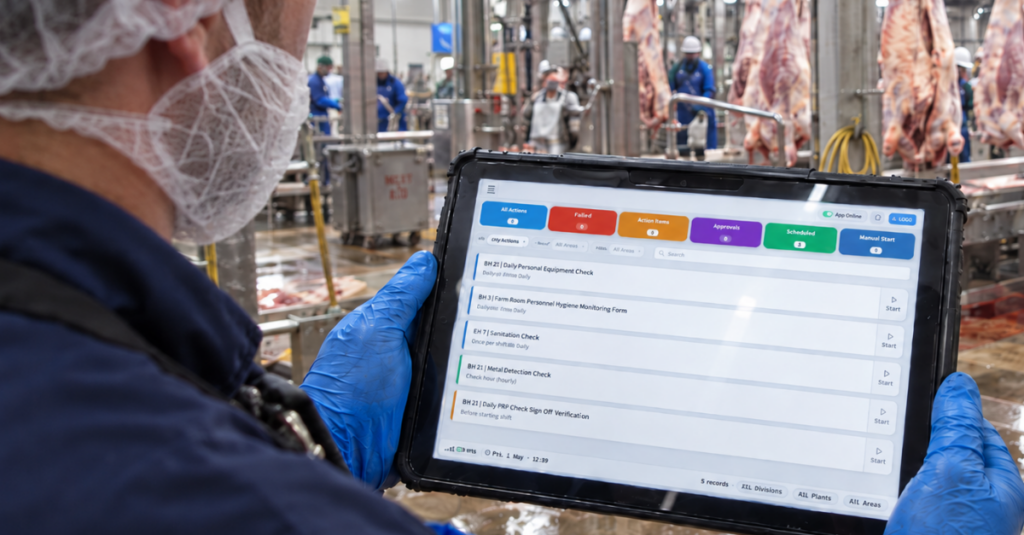
Every shift in a food processing plant produces quality records. Pre-operational checks, CCP monitoring, metal detection tests, label verification, and GMP walkarounds. Where these are still done on paper, the sheet is filled in on the line, brought back to the office, typed up and filed, then pulled out again when an auditor asks for it.
None of this means the checks are not being done. The limitation is the paper itself. A missed check only becomes visible when someone notices the gap in the file. An operator can be working from a specification that was superseded weeks ago, and every audit question starts with a search through compactors and lever arch folders.
The Emydex Electronic Quality Management System (EQMS) was built for food processing environments and is in daily use in meat, fish, and food processing plants worldwide. It is designed for the people who work in the factory: a simple interface with large buttons that operators can use with gloves on, so capturing data in real time takes no longer than the check itself. Quality requirements are set locally by regulators, export markets, retailer codes of practice and certification standards, and quality teams configure their own workflows to meet them.
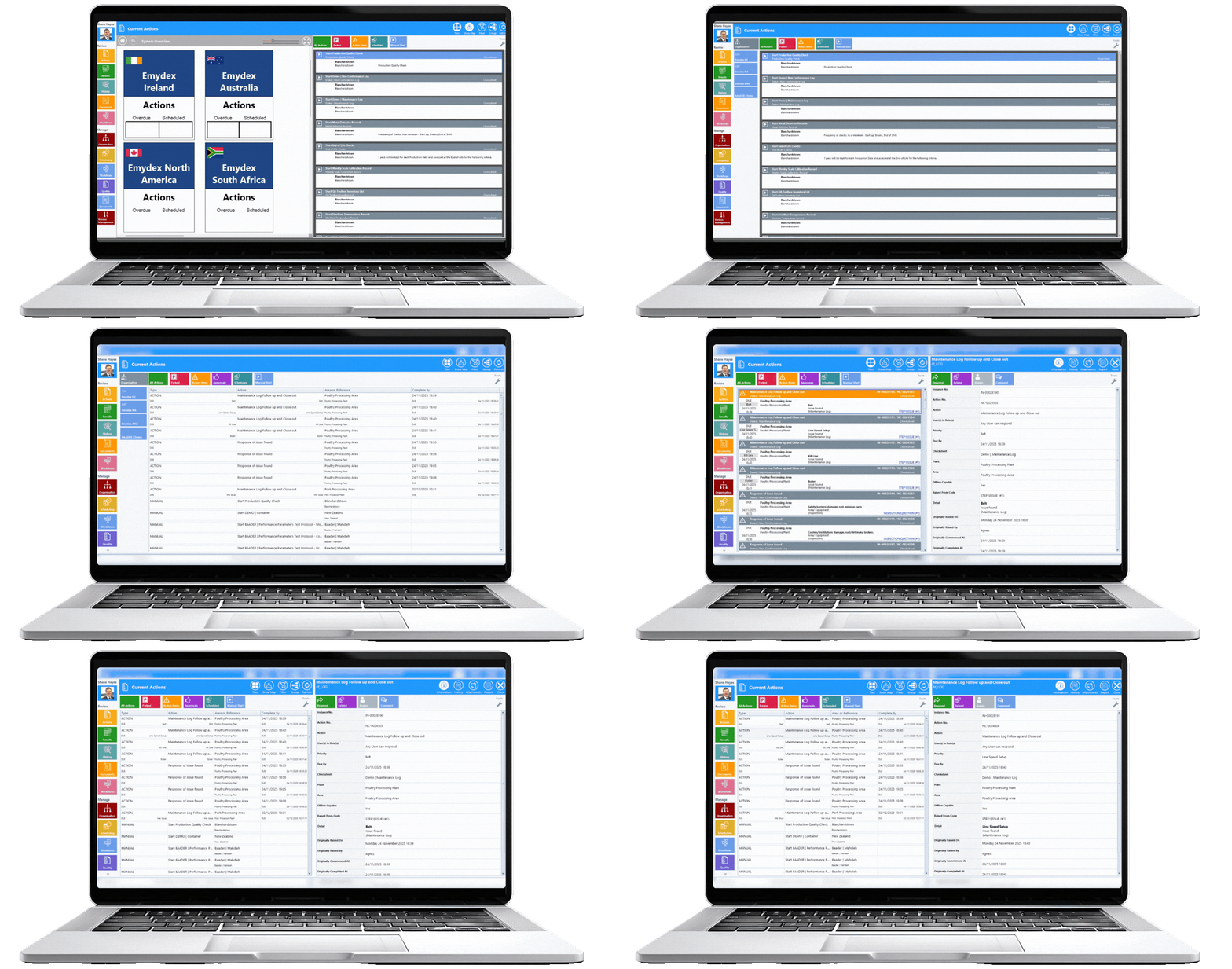
The Actions Console
The Actions Console is the first screen users see when they log in. It presents the checks, actions and notifications assigned to each user, controlled by user security, so a QC technician sees only the tasks for their own role and area. Scheduled work appears directly on the tablet, with no printed schedules to distribute.
Calendars and Schedules
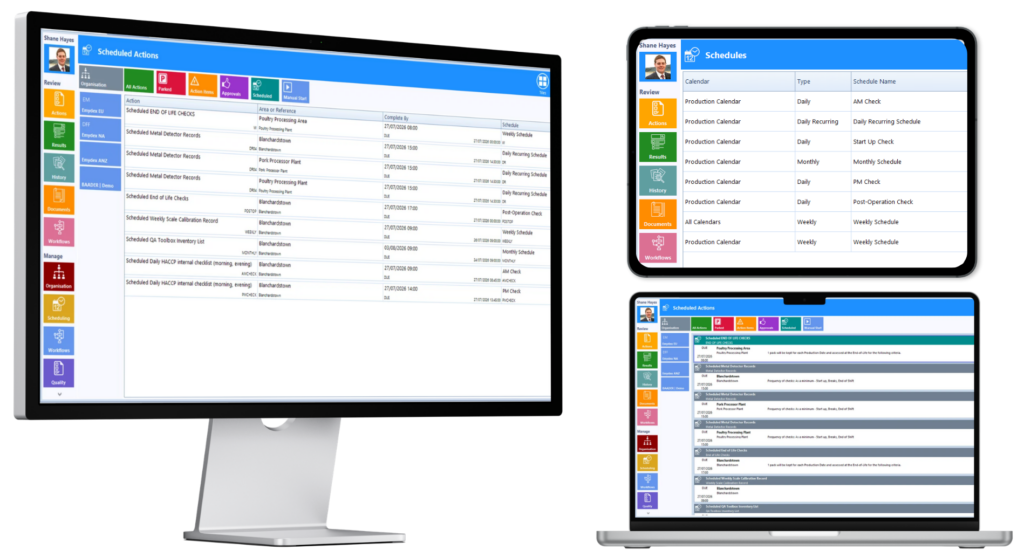
Behind the console sit production calendars. Operating hours are defined for each plant or area, and workflows are scheduled as required, hourly, daily, weekly or monthly, including pre-operational and post-operational checks.
For managers, the scheduling layer answers questions that paper never could. Which checks were missed this week, and why? Which started late? Which were completed in half the time the same check normally takes? That last measure deserves attention because completion speed is one of the few objective indications that a check was rushed. When a check is missed, the operator records the reason, and the system raises the follow-up automatically.
Workflows
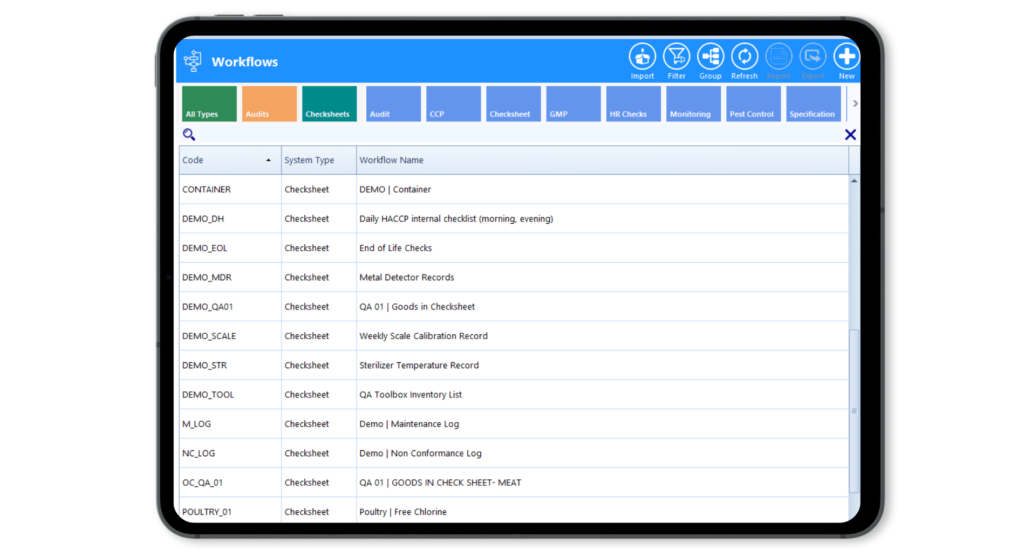
A workflow is a guided sequence of questions and data captures that takes an operator through an inspection step by step. Any check for a plant that currently runs on paper can be rebuilt in the system: GMP checks, metal detection, intake, label, product and carcass checks, glass and hard plastic audits, knife registers.
Results reach the central database as soon as a check is completed. If a result falls outside tolerance, the people who need to know receive an email or SMS while the product is still in production, not after dispatch. Operators capture photographs, video and digital signatures within the check itself, so the record shows what they saw and who signed it off. Checks completed offline, in chilled rooms or areas with poor network coverage, sync once the device reconnects.
At Murray’s Chicken in New York, the first tablets replaced paper clipboards six weeks after the project started. Teams there now complete over one hundred workflows a day. “All information is right at my fingertips,” says Phil Wise, Plant Manager. “I can see the checks being carried out in real time, without having to leave the office and go into the plant to find someone.”
The Workflow Builder
Workflows are built by the quality team, not by Emydex and not by the IT department. Quality and technical staff design, amend and release them in-house. Conditional paths mean the questions an operator sees depend on the answers already given. A passing metal detection check takes seconds. A failing one opens the follow-up questions; evidence capture and corrective actions that the failure requires.
Dawn Meats Group, one of Europe’s leading meat processing companies, has configured almost 500 QC workflows internally. They are built centrally and shared across the fourteen plants where the system operates. “This flexibility means we can build our own workflows ourselves, not involving Emydex nor internal IT,” says John Coleman, Group Food Safety and Quality Manager.
Results
Captured data needs to be usable. The built-in views and report designer let quality teams set up on-screen grids to filter, drill into and benchmark results across plants, along with formatted PDF reports for customers, auditors and certification bodies. Reports can be configured to match the exact layout of the paper sheets a plant uses today, so nothing changes for the auditors and customers who receive them. Audit preparation shortens accordingly, and the records support HACCP, BRCGS and ISO programmes. For dashboards, trends and KPIs, the data feeds the Emydex Business Intelligence module.
Document Storage and Version Control
SOPs, specifications and procedures are stored in the system and made available inside the checks where they are needed, so operators always work from the current approved version of a document. For multi-site groups, documents can be shared and accessed across plants.
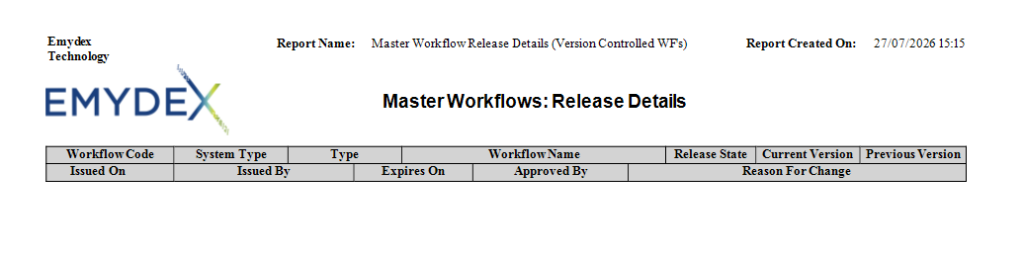
Version control covers documents and workflows alike. A back-office user checks out an item, works on it without touching what is live on the floor, and releases the new version through an approval process the customer configures. The history records who changed what, when and why. Once released, the new version is immediately available to production. There is no hunting for printed copies of SOPs, no shredding superseded versions, and no risk of a check running against an outdated document.
Corrective and preventative actions
When a check raises a non-conformance, the follow-up is managed in the system. The action goes to the right role, the assignee is notified, the due date is tracked, and the whole corrective and preventative action path stays attached to the original result. External auditors at Dawn Meats have commented on the system’s ability to generate reports, assign close-outs and collate data “at a click of a button”.
Connected to production
Most standalone quality apps have no production data behind them. The Emydex EQMS is tightly coupled with the Emydex production database, so an operator can scan a barcode during a check and validate the product on the line against live production and traceability records, instead of retyping details from a label. quality, production, and traceability work from one source of the truth.
Processors who want to start with quality alone can. The system runs standalone, in the cloud or on premises, for a single site or a multi-site group.
What it delivers
Customers using the system report a reduction of up to 80% in paper-based quality checks. Deviations are visible during the shift rather than at the end of it. Many customers also run occupational health and safety checks and preventative maintenance on the same platform.
The EQMS is part of the wider Emydex platform covering production, traceability, warehousing and business intelligence for food processors worldwide. To see the system working, request a demonstration.